


Finding a fragrance that balances sophistication with ethical values can feel overwhelming for eco-conscious scent lovers in New York City. The global standards set by organizations like the International Fragrance Association highlight the importance of ingredient purity and transparency when choosing a luxury-inspired perfume. This guide unpacks how ethical sourcing, sustainability, and artisanal quality shape affordable, vegan, and cruelty-free fragrances designed for urban lifestyles.
Table of Contents
- Defining Luxury-Inspired Fragrance Standards
- Signature Scent Profiles And Categories
- The Role Of Ingredients And Formulation
- Eco-Friendly And Cruelty-Free Commitments
- Affordability Versus Quality In Designer Doops
Key Takeaways
| Point | Details |
|---|---|
| Luxury Fragrance Standards | Luxury fragrances adhere to rigorous standards established by organizations like IFRA, ensuring ingredient purity, safety, and sustainability. |
| Distinct Characteristics | Luxury fragrances are characterized by their artisanal production, sophisticated molecular complexity, and commitment to cultural authenticity. |
| Ingredient Commitment | The formulation of luxury fragrances involves careful ingredient selection focused on molecular compatibility, sensory complexity, and ethical sourcing. |
| Ethical Consumerism | Modern luxury fragrances prioritize eco-friendly practices, transparency, and cruelty-free testing to appeal to conscious consumers. |
Defining Luxury-Inspired Fragrance Standards
Luxury-inspired fragrances represent more than just pleasant scents - they embody sophisticated sensory experiences rooted in meticulous craftsmanship and rigorous quality standards. Understanding these standards requires examining the intricate global frameworks that define exceptional perfumery.
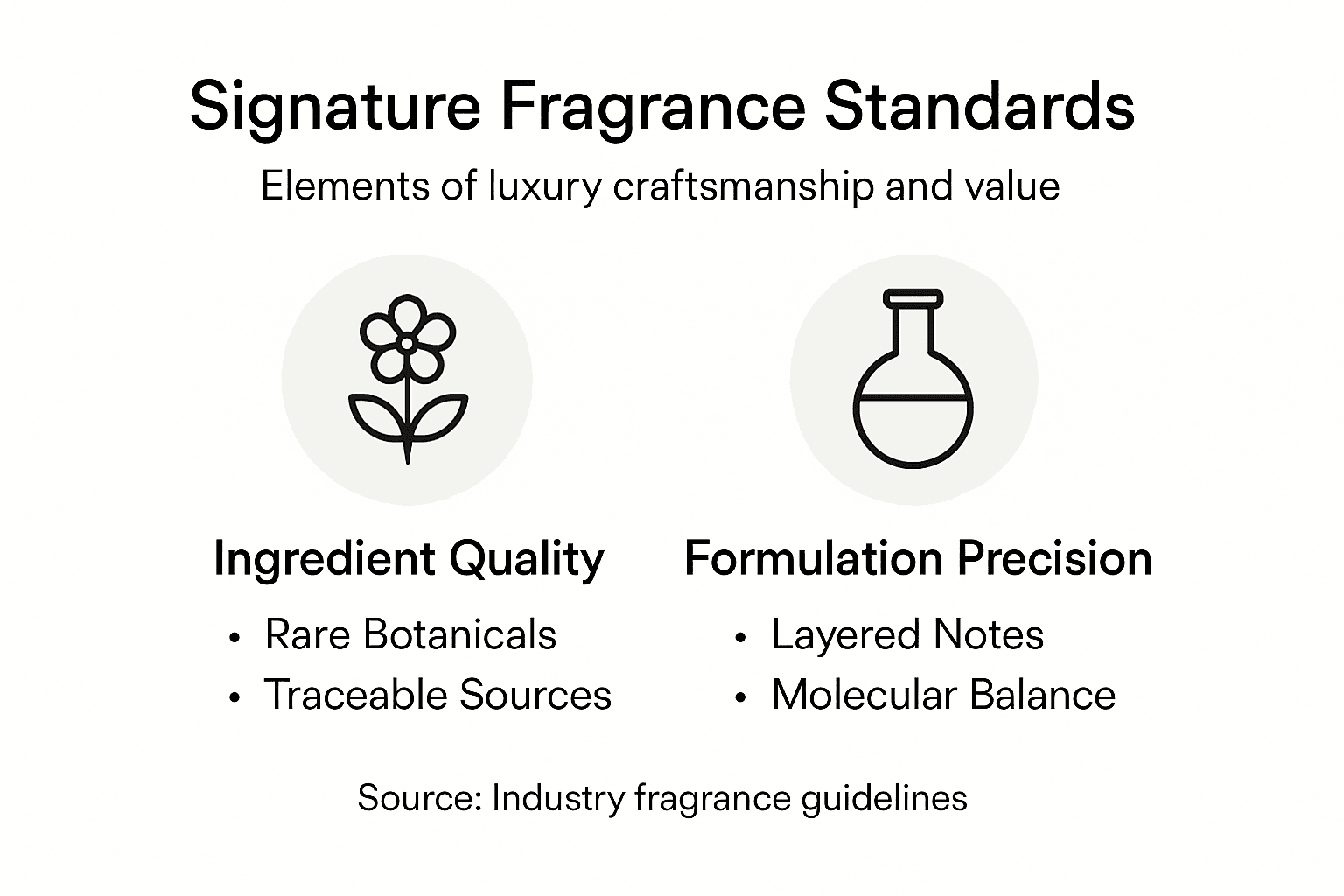
The International Fragrance Association (IFRA) establishes comprehensive guidelines that serve as the global benchmark for fragrance quality. Globally recognized fragrance standards ensure not just aesthetic excellence but also consumer safety and sustainable ingredient sourcing. These standards encompass multiple critical dimensions:
- Ingredient purity and transparency
- Comprehensive safety testing protocols
- Ethical sourcing requirements
- Environmental sustainability benchmarks
- Cultural heritage preservation
Unlike mass-market perfumes, luxury-inspired fragrances distinguish themselves through precise ingredient selection and artisanal production methodologies. The International Perfume Foundation emphasizes that true luxury fragrances transcend mere scent - they represent a narrative of cultural authenticity and environmental respect.
Professional perfumers consider multiple sophisticated criteria when developing luxury fragrances, including molecular complexity, rare botanical extractions, and sensory progression. These elements transform fragrance from a simple product into an immersive olfactory experience that communicates refinement and personal identity.
Pro tip: When evaluating luxury-inspired fragrances, look beyond marketing claims and examine the ingredient traceability, production ethics, and sensory complexity.
Here’s a consolidated overview of how luxury and mass-market fragrances differ:
| Characteristic | Luxury Fragrance | Mass-Market Fragrance |
|---|---|---|
| Ingredient Sourcing | Rare botanicals, ethical origins | Common synthetics, basic natural extracts |
| Production Method | Small-batch, artisanal | Large-scale, automated |
| Molecular Complexity | Highly layered, unique blends | Simple, often linear compositions |
| Storytelling | Cultural authenticity, personal narrative | Generic, trend-driven branding |
| Sustainability Focus | Strong, often certified | Limited, sometimes unverified |
Signature Scent Profiles and Categories
Luxury fragrances are distinguished by their complex and nuanced scent profiles, which go far beyond simple aromatic impressions. Professional perfumers craft these olfactory experiences through sophisticated molecular compositions that capture intricate sensory narratives.
Fragrance categories emerge from intricate volatile organic compounds that define unique sensory experiences. These fundamental scent profiles include:
- Floral Notes: Capturing delicate botanical essences
- Woody Accords: Representing deep, earthy undertones
- Citrus Elements: Providing bright, energetic top notes
- Oriental Compositions: Blending warm, complex aromas
- Fresh Aquatic Profiles: Suggesting crisp, clean sensations
Each fragrance category represents a sophisticated combination of molecular structures that interact dynamically with human olfactory receptors. Terpenoids, phenylpropanoids, and other complex organic compounds create layered sensory experiences that transform a simple scent into an emotional journey.

Professional perfumers approach scent design with scientific precision, understanding how different molecular structures interact to create harmonious or deliberately contrasting aromatic experiences. These signature profiles communicate not just a pleasant smell, but a narrative of personal style, cultural heritage, and individual expression.
Pro tip: Explore fragrances by understanding their foundational molecular structures rather than simply relying on marketing descriptions.
To help you quickly understand fragrance categories, here’s a reference table summarizing typical scent profiles and their main associations:
| Category | Typical Aromatic Traits | Common Emotional Effect |
|---|---|---|
| Floral | Soft, elegant, powdery | Romantic, calming |
| Woody | Earthy, resinous, rich | Grounding, sophisticated |
| Citrus | Bright, zesty, tangy | Energizing, fresh |
| Oriental | Warm, spicy, opulent | Sensual, mysterious |
| Aquatic | Clean, breezy, crisp | Refreshing, invigorating |
The Role of Ingredients and Formulation
Luxury fragrances emerge from a sophisticated interplay of carefully selected ingredients, where each molecular component plays a critical role in creating an extraordinary sensory experience. The art of fragrance formulation transcends simple ingredient mixing - it represents a complex scientific and creative process.
Systematic ingredient testing and selection determines the ultimate quality and character of a luxury fragrance. Professional perfumers employ multiple strategic approaches to ingredient integration:
- Molecular Compatibility: Ensuring harmonious interactions between compounds
- Stability Assessment: Evaluating long-term performance and preservation
- Sensory Complexity: Designing multi-layered aromatic experiences
- Regulatory Compliance: Meeting international safety standards
- Sustainability Considerations: Selecting ethically sourced ingredients
The ingredient hierarchy in luxury fragrances typically follows a precise structure. Base notes provide foundational depth, middle notes create complexity, and top notes deliver initial sensory impressions. This carefully orchestrated arrangement transforms individual ingredients into a cohesive, emotionally resonant olfactory narrative.
Advanced formulation techniques allow perfumers to manipulate molecular interactions, creating signature scents that communicate sophistication, personal identity, and emotional nuance. Each ingredient is selected not just for its individual characteristics, but for its potential to contribute to a larger, more complex aromatic composition.
Pro tip: Evaluate fragrances by understanding the intentional progression of their molecular layers, not just their initial impression.
Eco-Friendly and Cruelty-Free Commitments
Luxury fragrances today represent more than sensory experiences - they embody profound ethical and environmental commitments that resonate with conscious consumers seeking responsible beauty solutions. Modern fragrance enthusiasts demand transparency, sustainability, and compassionate production practices.
Comprehensive sustainability assessments have transformed the fragrance industry’s approach to environmental responsibility. Key focus areas include:
- Ingredient Sourcing: Prioritizing renewable and traceable materials
- Production Processes: Minimizing carbon footprint and waste
- Packaging Design: Using recycled and biodegradable materials
- Ethical Testing: Eliminating animal testing completely
- Supply Chain Transparency: Ensuring fair labor practices
The International Fragrance Association plays a critical role in establishing global standards for environmentally conscious fragrance production. These standards encompass not just ingredient selection, but holistic approaches to reducing environmental impact and promoting ethical manufacturing practices.
Advanced green chemistry techniques now allow perfumers to create complex, luxurious fragrances while maintaining stringent environmental and ethical standards. This approach demonstrates that luxury and sustainability are not mutually exclusive, but can be beautifully integrated to create products that honor both sensory excellence and planetary responsibility.
Pro tip: Research fragrance brands by examining their complete sustainability report, not just marketing claims.
Affordability Versus Quality in Designer Doops
The fragrance market has undergone a transformative shift, with consumer demand for luxury-inspired scents creating a nuanced landscape of designer alternatives and affordable options. Modern fragrance enthusiasts seek sophisticated experiences without astronomical price tags, driving the evolution of designer doops.
Complex legal considerations shape the designer doop marketplace, influencing how brands approach affordable fragrance alternatives. Key factors consumers should evaluate include:
- Ingredient Quality: Comparing molecular composition
- Longevity: Measuring scent retention capabilities
- Molecular Complexity: Assessing aromatic depth
- Price-to-Performance Ratio: Evaluating cost effectiveness
- Ethical Production: Examining manufacturing standards
The tension between affordability and quality represents a sophisticated consumer calculus. While designer doops offer accessible luxury, they frequently compromise on nuanced molecular structures that define high-end fragrances. Sophisticated consumers understand that true value transcends simple price comparisons.
Advanced fragrance technologies now enable manufacturers to create increasingly sophisticated alternatives that approach - and sometimes exceed - the sensory experiences of premium brands. This evolution challenges traditional perceptions of luxury, democratizing high-quality olfactory experiences for discerning consumers.
Pro tip: Always sample fragrance doops directly to understand their unique molecular profile and personal compatibility.
Experience True Luxury Without Compromise
The challenge highlighted in the article is clear luxury-inspired fragrances often come with high costs, questionable ingredient transparency, and a lack of ethical production practices. You want a scent that delivers molecular complexity, artisanal quality, and cruelty-free values but without the boutique markups or uncertainty about sustainability. At Parfum.NYC, we understand these pain points. Our curated collection features high-quality extrait de parfum inspired by iconic luxury fragrances that combine premium formulations with clean, vegan ingredients. You can enjoy sophisticated scent families like floral, woody, and gourmand crafted with ethical sourcing and rigorous quality standards, all designed to capture your personal narrative and identity through fragrance.

Explore Parfum.NYC today and discover how you can indulge in luxurious, cruelty-free scents that resonate with your values and style. Take advantage of our free shipping, 30-day satisfaction returns, and personalized scent finder quiz to find your perfect match. Elevate your fragrance experience with designer-inspired perfumes that respect both your wallet and the planet. Start your journey now by visiting our home page and embracing luxury the mindful way.
Frequently Asked Questions
What defines a luxury-inspired fragrance?
Luxury-inspired fragrances are characterized by their sophisticated sensory experiences, meticulous craftsmanship, and adherence to rigorous quality standards established by organizations like the International Fragrance Association (IFRA).
How do luxury fragrances differ from mass-market options?
Luxury fragrances typically focus on rare botanicals and artisanal production methods, resulting in complex, multi-layered scents. In contrast, mass-market fragrances often use common synthetics and have simpler compositions.
What ingredients play a critical role in luxury fragrances?
Luxury fragrances utilize a range of meticulously selected ingredients, including rare botanical extractions and complex molecular structures that interact dynamically to create layered sensory experiences.
Are luxury-inspired fragrances eco-friendly and cruelty-free?
Many luxury-inspired fragrances today prioritize sustainability and ethical practices, focusing on responsible ingredient sourcing, environmentally friendly production processes, and eliminating animal testing.


